
Client records
To begin with, we prepare several separate databases for you: a database of residential buildings and a database of clients. We can import your existing data into the system for you, but we will need it in an open format (Excel, Word, CSV and so on).
In the overview of each database we add the data (columns) you need for filtering. Do you need to filter buildings by city district? No problem, we add a "City district" column and you filter by it. Or do you need to filter clients by whether they have an unpaid fee or invoice? We simply add an "Overdue invoice" column and you filter such clients with a Yes/No filter.
You can filter clients or buildings by any criterion directly in your system. Filters can be combined (for example, you can find clients whose buildings are managed by a given employee and who also have an overdue payment or invoice).
If you need another client database, no problem. It is entirely up to you which client databases you want to see in the system and which data you can filter in them.

Client and building detail
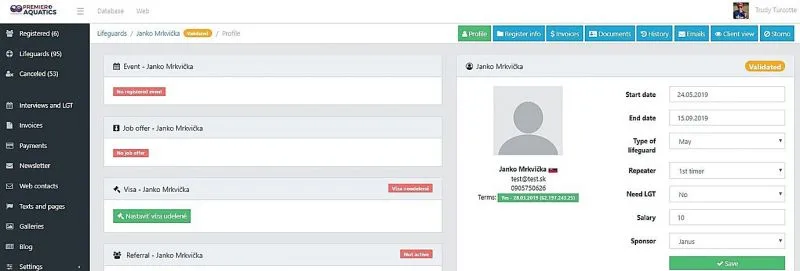
Once you have found a client or a building, you can open its detail. For individual clients (natural persons) you see personal data (address, date of birth, assigned building, contacts), invoices, payment details, the annual statement, open and closed requests, the history of e-mail communication, contracts and so on. We are probably repeating ourselves, but everything is made to measure, exactly the way you need it.
For buildings you see, for example, the costs of the building, open requests, closed requests, assigned clients and overdue invoices. For every building we also add clear statistics (annual statement, consumption, number of call-outs, statistics of requests and interventions and so on).
Client account
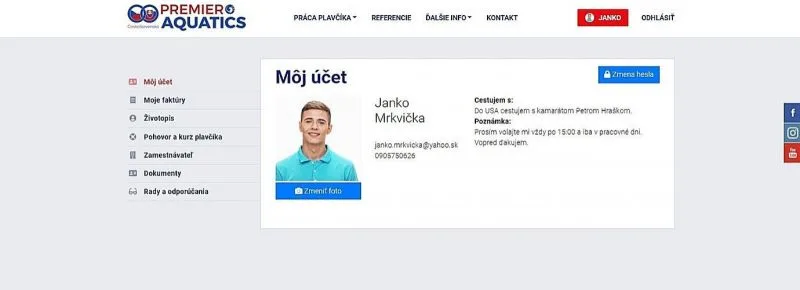
Almost every client would like to check the status of their payments, balance due, arrears, annual statement, PDF contract and so on. At the same time, few clients want to create a separate account, generate a password and go through a complicated login.
Clients (flat owners) can log in to their account in a simplified way: an e-mail and a specific identifier (for example date of birth) are enough. For security we can add another identifier, for example the client's variable symbol or a choice of building.
You can make any information available to the client in their account. Do you want them to see the generated PDF contract they signed? No problem. If you do the annual statement through your new system, you can make the electronic statement available as well.
You can also give the client an overview of payments, an overview of the building's costs (received invoices), a calendar of planned maintenance, an overview of completed repairs, inspections and maintenance and so on.
Automatic invoices and recording of payments
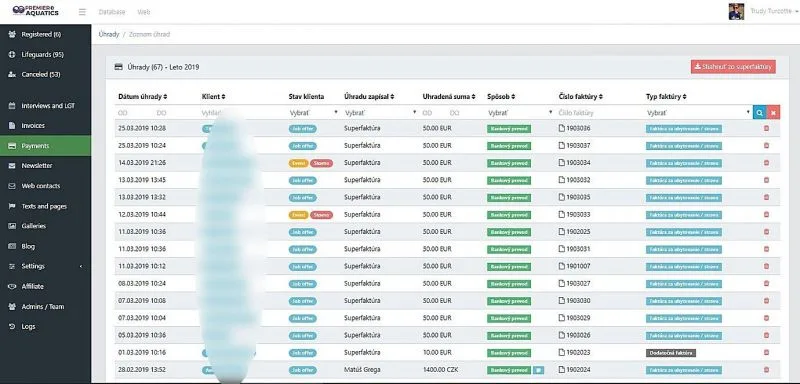
Your system will automatically record payments received on your bank account and match them to specific clients and invoices by the variable symbol, which is unique for every client.
From time to time it is enough to check unpaid invoices and see whether they were paid with a wrong variable symbol, so that you can add the payment manually. According to our clients' statistics, the correct variable symbol is entered in more than 98% of payments (for recurring payments in more than 99.9% of cases).
Generating contracts for clients
Until now you (probably) had to fill in a contract for every new client, or clients sent it to you filled in. From now on the system does it for you. Either you enter the client's data (manually), or you send the client an e-mail inviting them to register (the client enters all the data). You then generate the contract as a PDF, which you can send by e-mail or post (we can also connect your system to an external postal service provider: at the press of a button the provider receives the PDF contracts and the recipient's details and posts the item for you).
A complete record of communication with the client
All e-mails you send to a client through the system are automatically saved in the history of e-mail communication with that client. Incoming e-mails can also be set up to be saved directly under the client's account, so you have the whole course of e-mail communication under control.
If you are a larger company and want full control over phone communication too, we can connect your system to a VoIP telephone exchange. Your telecommunications bills go down (you call over the internet and need only an internet connection), and every call from a client is automatically recorded in your system (the length of the call; calls can be recorded as well).
Bulk mailings at the post office
If you send many items by post, our export for the electronic posting sheet (ePodací hárok) may help. How does it work? You create an online account on the Slovak Post website. In the Slovak Post system you create electronic posting sheets, where you enter the recipients' details in advance, and then you only bring your items to the post office.
To make this as easy as possible, you can export the data of any clients from your system to an Excel file, which you then upload to the Slovak Post system, so you don't waste time retyping addresses. More about the electronic posting sheet can be found here.
Besides fewer errors and time saved, Slovak Post rewards you with lower fees when you use the electronic posting sheet.

Ticketing system
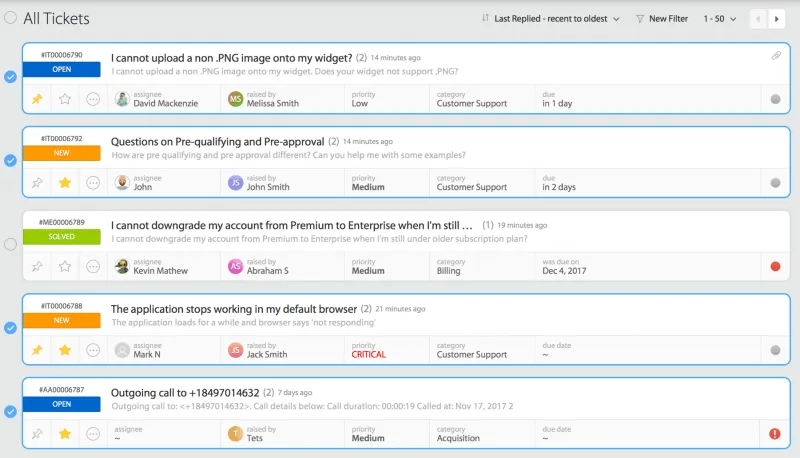
We can also build this handy feature into your new system: ticketing. What is it? When a client calls to say the roof of their building is leaking, the call-centre operator (or the responsible employee) creates a "ticket", in other words a task. When creating the task you assign the people who will handle it and the clients (for example the building), a priority (high, medium, low) and optionally a category (phone call, fault, interest in services).
As soon as the task is resolved, an employee closes it in the system. While the task is in progress, or if it is a more complex team task, all assigned employees can add comments. A notification of a new comment is also sent to the assigned employees by e-mail (or the author of the comment chooses who receives the e-mail notification).
Even trivial tasks can be handled this way ("Mr Novák called, call him back after your holiday") and you don't have to write the employee an e-mail. It is more efficient (the employee has to close the task, so you know it is done) and you have a perfect overview of your employees' work.
You can also make tasks visible to clients and buildings, so they have an overview of the repairs carried out during the year and of those currently in progress. For urgent tasks you can also inform all clients of a building (or an entrance) by e-mail, for example about a burst water pipe, a damaged gas meter or a flooded cellar.
Timer
Perhaps it often happens that a client (for example the building's representative) tells you on the phone "I can't talk right now, try calling me in an hour". You get busy, another client arrives for a meeting and you simply forget the call "in an hour". That is why we can add a Timer to every client: you note the date and time when you can call, add a note, and at exactly that time the system sends you an e-mail reminding you of the call or another note.
You can use the Timer for anything. Make a note not to forget to send a client the contract in the evening, to check that an invoice has been paid in full, or to order a plumber. The Timer has unlimited uses, and once you get used to it, it will be hard to imagine a better reminder.
We also add a filter for clients and buildings with an active timer to your client database, so your work is even simpler and more efficient.
A final word
There really are many solutions we can provide. A new system can also be introduced gradually, for example if you don't want to invest a large sum at once. This approach has another advantage: employees get used to the new system step by step, it is not a big leap for them, and they can take an active part in its development and comment on its features.
At CKM 2000 Travel, for example (Matúš then still an employee of the company and Šimon an independent web developer), in the first year we implemented the client database, generation of PDF contracts and sign-up for visa interviews. The next year we improved the system based on employees' requests and added invoice generation with recording of payments. In the third year we added automatic calculation of the travel insurance price, generation of insurance, sign-up for events (interviews with employers), an online branch and more.
A gradual start has its advantages, but also its disadvantages. The disadvantage is that at the beginning people do not see and use all the benefits the system can bring, so the organisation introducing it does not use all the suitable features (and so does not save as much time, cost and, in the end, money).